Walk into any hardware store, scroll through Amazon, or browse a BBQ specialty retailer and you will face the same fundamental question: stainless steel or painted steel?
It is easy to get distracted by burner counts, side shelves, and Bluetooth thermometers. But the material of the grill body and cooking grate determines whether your grill lasts three years or fifteen. Everything else is secondary.
This article breaks down the real differences between stainless steel and painted (or powder-coated) BBQ grills — not the marketing claims, but what actually happens after seasons of heat, rain, and heavy use.
The Core Difference: What Each Material Actually Is
Stainless Steel
Stainless steel is a steel alloy containing at least 10.5% chromium. The chromium reacts with oxygen to form a thin, invisible layer of chromium oxide on the surface. This is the “passive layer” — it is self-healing and prevents rust from penetrating the metal.
The grade matters more than the label. Not all “ステンレス鋼” is created equal:
| Grade | Composition | Rust Resistance | Heat Performance | Common Use in BBQ Grills |
|---|---|---|---|---|
| 304 (18/8) | 18% chromium, 8% nickel | Excellent — rust-proof in all but the harshest marine environments | Excellent — retains strength at high temperatures | Premium grills, food-contact surfaces, commercial equipment |
| 430 | 16-18% chromium, no nickel | Good — rust-resistant but may show surface oxidation over years | Good | Mid-range grills, exterior panels |
| 201 | Lower nickel, higher manganese | Moderate — more prone to pitting and discoloration | Moderate | Budget grills marketed as “stainless” |
Critical distinction: A grill labeled simply “ステンレス鋼” without specifying the grade is almost certainly 201 or 430 — not 304. If the manufacturer uses 304, they will tell you. Loudly.
Painted / Powder-Coated Steel
Painted steel is carbon steel with a layer of paint or powder coating applied to the surface. The steel itself has no rust resistance — the coating is the only barrier between the metal and the environment.
| Coating Type | Durability | Heat Tolerance | Typical Lifespan |
|---|---|---|---|
| Powder coating (electrostatically applied, oven-cured) | Good — harder than wet paint, resists chipping | Moderate — degrades above 400°F | 3-7 years |
| High-temperature paint | Moderate — formulated for heat, but softer surface | Good — rated to 800-1200°F | 2-5 years |
| Porcelain enamel (glass fused to steel) | Excellent — hard, non-porous, rust-proof | Excellent | 10+ years (but brittle — cracks on impact) |
| Standard wet paint | Poor — scratches easily | Poor — blisters and peels under heat | 1-3 years |
Head-to-Head Comparison
1. Rust and Corrosion Resistance
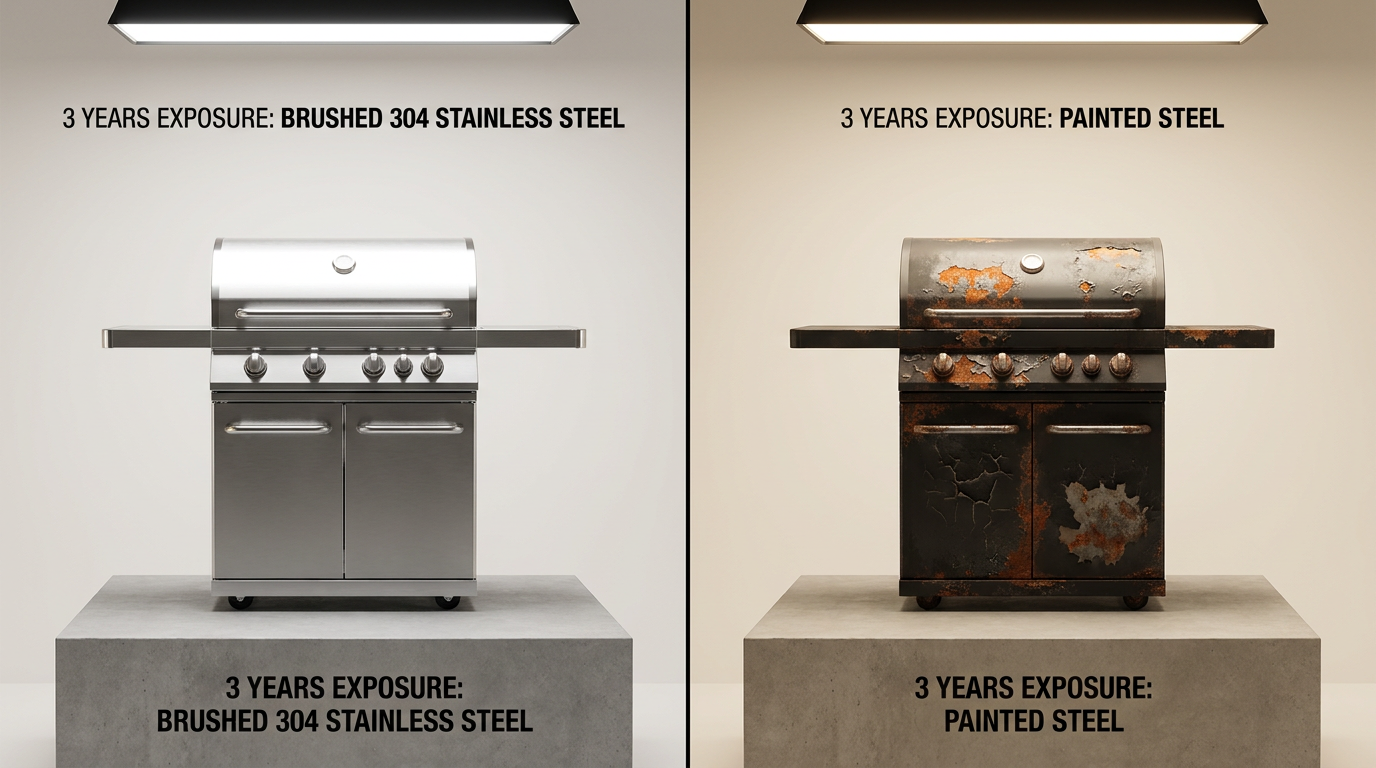
Winner: 304 Stainless Steel
This is the battlefield where stainless steel earns its price premium.
- 304 stainless: The passive chromium oxide layer self-repairs if scratched. A grill stored outdoors near the coast will still look good after a decade. Surface tea-staining (a cosmetic brown discoloration) can occur in extreme salt environments but is removable with a stainless steel cleaner.
- 430 stainless: Good resistance for inland use. May show minor surface rust spots after 5+ years outdoors, especially near coastal areas. These spots are cosmetic and can be cleaned.
- Powder-coated steel: Works perfectly — until it does not. A single scratch, chip, or heat-induced blister exposes bare steel. Once the barrier is breached, rust spreads underneath the coating like a cancer. By the time you can see the rust, the damage underneath is much larger.
- Painted steel (non-powder): Even a well-cared-for painted grill will show rust around joints, bolt holes, and heat-affected areas within 2-3 seasons. The paint simply cannot handle the thermal expansion and contraction of repeated heating cycles.
Real-world test: Leave a painted steel grill and a 304 stainless grill outside uncovered for one winter. Next spring, the painted grill will have rust. The stainless grill will need a wipe-down.
2. Heat Performance and Cooking Quality
Winner: Stainless Steel (with a caveat)
- Stainless steel grates heat up quickly and evenly. They do not retain heat as long as cast iron, but for direct grilling (steaks, burgers, chops), they produce excellent sear marks and release food well when properly oiled.
- Stainless steel grill bodies reflect radiant heat back toward the food, improving cooking efficiency compared to painted bodies that absorb and re-radiate heat less effectively.
- Painted steel performs adequately for heat retention in the body, but painted grates are a non-starter for serious cooking — paint and food should never mix. Most painted grills use separate grate materials (often chrome-plated or porcelain-coated), adding another layer of material quality to evaluate.
The caveat: For low-and-slow smoking, cast iron or heavy steel retains heat better than stainless. But for the 90% of use cases — direct grilling — stainless steel is the superior material.
3. Maintenance and Cleaning
Winner: Stainless Steel
| Task | Stainless Steel | Painted Steel |
|---|---|---|
| Routine cleaning | Wipe with stainless cleaner or mild soap + water. Done. | Careful cleaning to avoid scratching the coating. No abrasive cleaners. |
| Rust treatment | Rub spot with stainless cleaner. Oxide layer self-heals. | Sand down rust, treat with rust converter, repaint. Repeat annually. |
| Grease removal | Degreaser or baking soda paste. No damage risk. | Degreasers may dull the paint finish. Test in an inconspicuous area. |
| Winter storage | Cover recommended but not mandatory for 304. | Cover mandatory. Any moisture ingress through coating chips = rust. |
If you want to spend more time grilling and less time maintaining, stainless steel is the clear answer.
4. Aesthetics Over Time
Winner: Stainless Steel
A brushed stainless steel grill looks almost as good on year ten as it did on day one. Minor surface scratches blend into the brushed finish. The color does not fade because it is the color of the metal itself.
A painted grill starts its life looking sharp — often available in more color options than stainless. But after two summers of sun exposure, the black fades to dark gray. The red fades to dull brick. Heat-affected areas near the firebox discolor permanently.
If the grill is a focal point of your outdoor space — and for most serious BBQ setups, it is — aesthetics matter.
5. Cost: Upfront vs. Long-Term
Winner: Depends on Your Time Horizon
Let us run the numbers on a typical mid-size freestanding grill:
| Scenario | Stainless (304) | Powder-Coated Steel |
|---|---|---|
| Purchase price | $800 – $1,500 | $200 – $500 |
| Expected lifespan | 12-18 years | 3-6 years |
| Annual maintenance cost | $10-20 (cleaner, cover) | $20-50 (paint, rust treatment, earlier cover replacement) |
| Replacement cost over 15 years | $0 (one grill) | $400-1,500 (2-3 replacement grills) |
| True 15-year cost | $800-$1,500 | $600-$2,000+ |
The math is clear: a quality stainless steel grill costs less over a decade-plus of ownership when you factor in replacements. The painted grill wins only if you plan to replace it within 3-5 years regardless — or if the upfront cash is the limiting factor.
When Should You Buy a Painted Grill?
Stainless is better in almost every measurable way, but painted grills still have valid use cases:
- You are on a tight budget and need a grill today. A $300 powder-coated grill that gets you cooking this weekend beats saving for two years while eating microwaved dinners.
- You grill fewer than 10 times per year. Light use reduces thermal cycling stress. A well-maintained powder-coated grill can last 6-8 years under occasional use.
- You need a specific color. Stainless is silver. If your outdoor kitchen demands matte black or fire-engine red, a high-quality powder coat is your only option.
- You want a grill for a rental property or vacation home where you cannot control how it is maintained. Accept the shorter lifespan as the cost of doing business.
The Food-Safety Angle
Here is something most buyers never consider: the material of the cooking grate directly contacts your food.
304 stainless steel is the industry standard for food-processing equipment worldwide. It is non-reactive, does not leach chemicals, and meets FDA requirements for food-contact surfaces.
Painted or coated grates pose risks:
– Chrome-plated grates: The plating can flake into food as it ages. Chromium compounds are not something you want in your burger.
– Porcelain-coated grates: Safe when intact, but once chipped, the underlying steel rusts and contaminates the cooking surface.
– Painted grates: No reputable manufacturer paints the cooking grate itself, but painted interior components near the grate can off-gas when overheated.
For food safety alone, insist on 304 stainless steel for any surface that touches food.
Final Verdict
| If you… | Buy… |
|---|---|
| Want a grill that outlasts your mortgage | 304 ステンレス鋼 |
| Grill 3-4 times a week, year-round | 304 ステンレス鋼 |
| Live near the ocean | 304 ステンレス鋼 (mandatory) |
| Entertain frequently and care about appearance | 304 ステンレス鋼 |
| Are on a tight budget and grill occasionally | Quality powder-coated steel |
| Need a temporary or secondary grill | Painted steel |
| Operate a commercial kitchen | 304 ステンレス鋼, NSF-certified |
The market is moving decisively toward stainless steel for a reason. As manufacturing costs come down and consumer expectations rise, painted steel grills are steadily being relegated to the disposable end of the market.
Buy once, buy stainless. Your future self — standing over a 12-year-old grill that still looks and cooks like new — will thank you.
Toshine manufactures BBQ grills with 304 stainless steel for all food-contact surfaces — including grill grates, 串刺し棒, and inner liners. Contact us for OEM inquiries, bulk pricing, or to explore our full stainless steel grill catalog.