Whole animal roasting is the pinnacle of outdoor live-fire catering, commercial BBQ hospitality, and event banquets. Whether you are roasting a 40 kg whole lamb, a 60 kg whole hog, or multiple suckling pigs simultaneously, achieving uniform heat penetration, crisp crackling, and succulent meat requires specialized mechanical engineering.
Unlike standard backyard BBQ rotisseries that struggle under uncentered loads, a commercial-grade rotisserie spit roaster is designed for high torque, rigid mechanical stability, and continuous multi-hour thermal endurance. This comprehensive guide details the essential technical criteria, motor torque dynamics, structural designs, and commercial selection factors for 2026.
1. Anatomy of a Commercial Spit Roaster
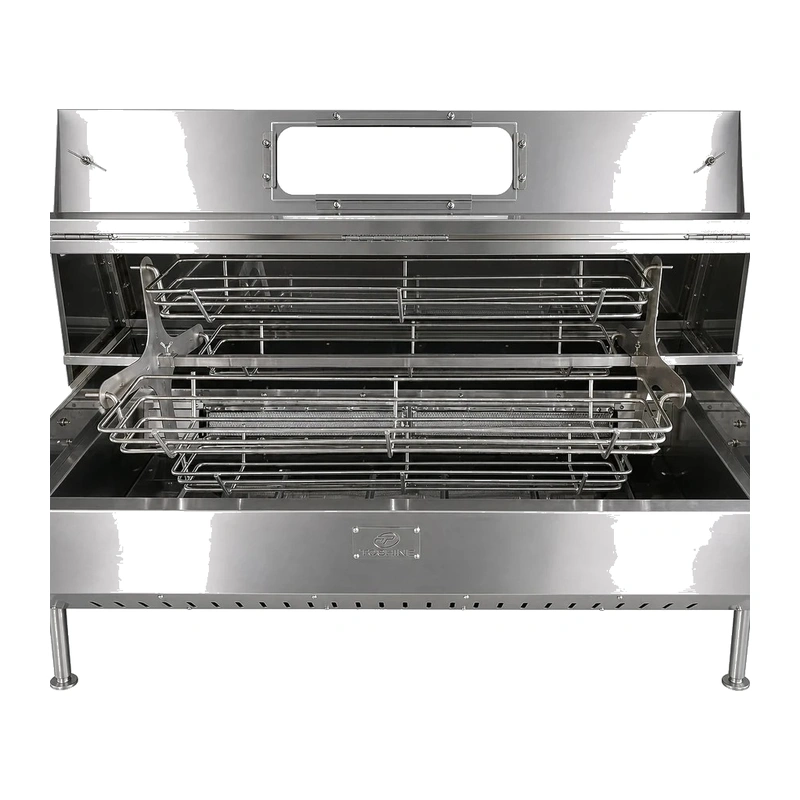
A heavy-duty spit roasting system comprises five critical sub-assemblies:
- Heavy-Gauge Firebox & Charcoal Trough: Fabricated from 1.5mm to 2.5mm thick SUS304 or 430 stainless steel with reinforced internal gussets, integrated heat shields, and drainage channels.
- Solid Spit Rod (Shaft): High-tensile solid stainless steel or heavy-wall tubular profile (22mm to 28mm diameter / hexagonal profile) engineered to eliminate shaft sagging under heavy, asymmetric payloads.
- Dual Height-Adjustment Uprights: Laser-cut multi-position slot pillars or continuous lead-screw mechanisms allowing 150mm to 450mm clearance adjustments above the coal bed.
- Spit Accessories & Meat Clamps: 4-prong heavy-duty locking forks, stainless steel U-bolts, back spine clamps, and leg braces to firmly secure whole carcasses without slippage during rotation.
- Mobility & Base Chassis: Industrial swivel caster wheels with 360-degree dual-locking brakes, supporting mobile catering transport across uneven outdoor terrain.
2. High-Torque Spit Motors: The Engineering Heart
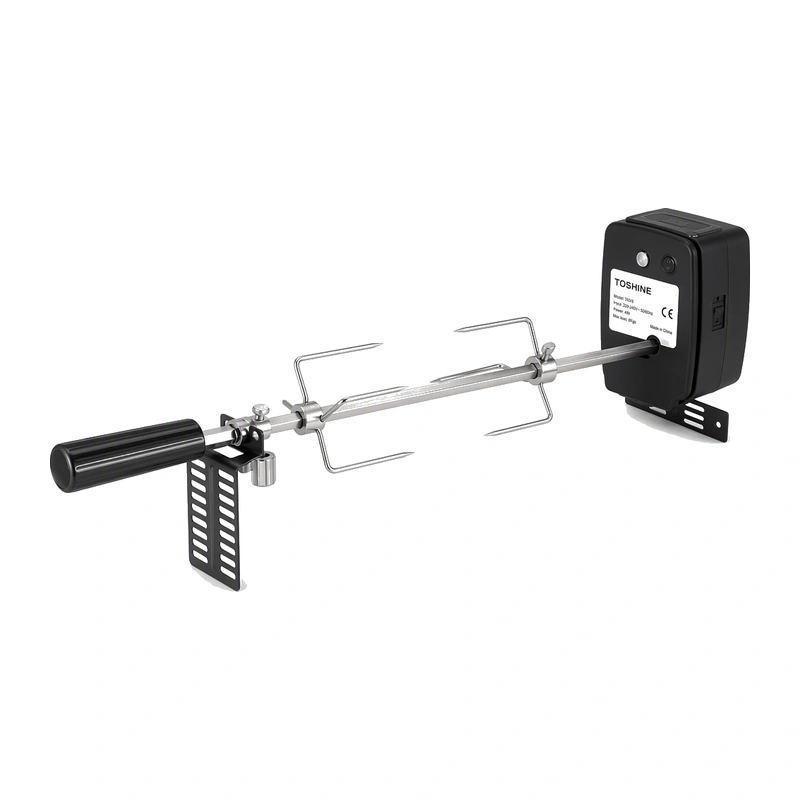
The motor is the most mission-critical component of any whole animal rotisserie. When an animal rotates, its center of gravity constantly shifts. When rotating upwards against gravity, instantaneous peak torque spikes significantly beyond static nominal load.
Key Motor Technical Specifications
- Motor Power & Voltage: Available in 45W, 60W, and 120W AC models (110V/220V/240V 50/60Hz) as well as 12V/24V DC battery/inverter-compatible versions for off-grid catering.
- Optimal Rotation Speed (RPM): 2.5 A 5.0 RPM. At this rotation speed, fat continually self-bastes the meat without dripping excessively onto the coals, preventing uncontrolled flare-ups.
- All-Metal Precision Gearbox: Precision-machined steel and phosphor-bronze reduction gears replace standard consumer nylon gears, preventing gear stripping under sudden eccentric torque shocks.
- Internal Cooling Fan & Thermal Cutout: Heavy-duty fan-cooled motor housing with class-F thermal insulation and automatic resettable thermal overload protection.
- IP54 / IP65 Weatherproof Enclosure: Sealed SUS304 stainless steel housing protecting motor windings from grease vapor, piovere, and radiant embers.
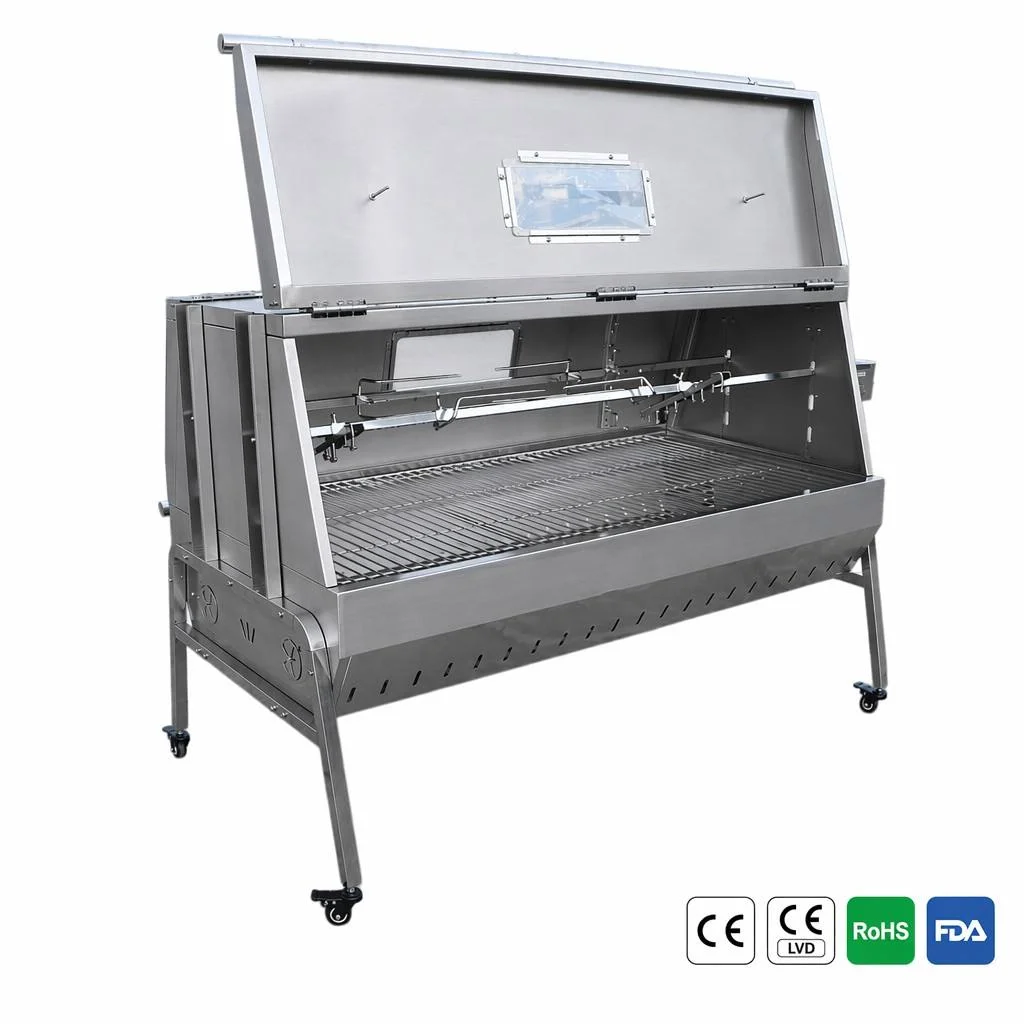
3. Commercial Spit Roaster Comparison & Capacity Guide
| Model Category | Max Balanced Load | Motor Spec | Spit Length / Dia. | Primary Application |
|---|---|---|---|---|
| Compact Catering / Lamb Roaster | 30 – 40 kg | 30W – 45W AC (50 kg-cm) | 1200 mm / Ø20 mm | Small events, suckling pigs, poultry, gyros |
| Commercial Whole Pig & Hog Roaster | 60 – 80 kg | 60W – 90W AC (90 kg-cm) | 1500 mm / Ø22 mm Hex | Whole large pigs, whole sheep, banquet catering |
| Heavy-Duty Industrial Dual-Spit System | 100 – 120 kg total | Dual 60W / 120W Synchronous | 1600 mm / Ø25 mm Solid | Commercial smokehouses, festival catering, OEM brands |
4. Carcass Balancing & Operational Best Practices
Even with a 100 kg-rated motor, poor carcass balancing creates extreme peak torque that can cause motor shudder, excessive gearbox wear, or premature clutch slip.
- Centering the Spine: Insert the spit rod as close to the animal’s natural spine line as possible to minimize eccentric moment arms.
- Four-Point Locking: Fasten dual 4-prong heavy forks into the shoulders and hindquarters, ensuring thumbscrews are torqued down securely.
- Spine Bracing & U-Bolts: Fasten stainless steel back braces through the spine cavity to prevent carcass bowing during contraction over heat.
- Counterbalance Weight: Utilize an adjustable collar counterbalance weight on the non-driven end to offset heavy ribcage or leg bias before ignition.
5. OEM / ODM Manufacturing & Custom Engineering at Toshine
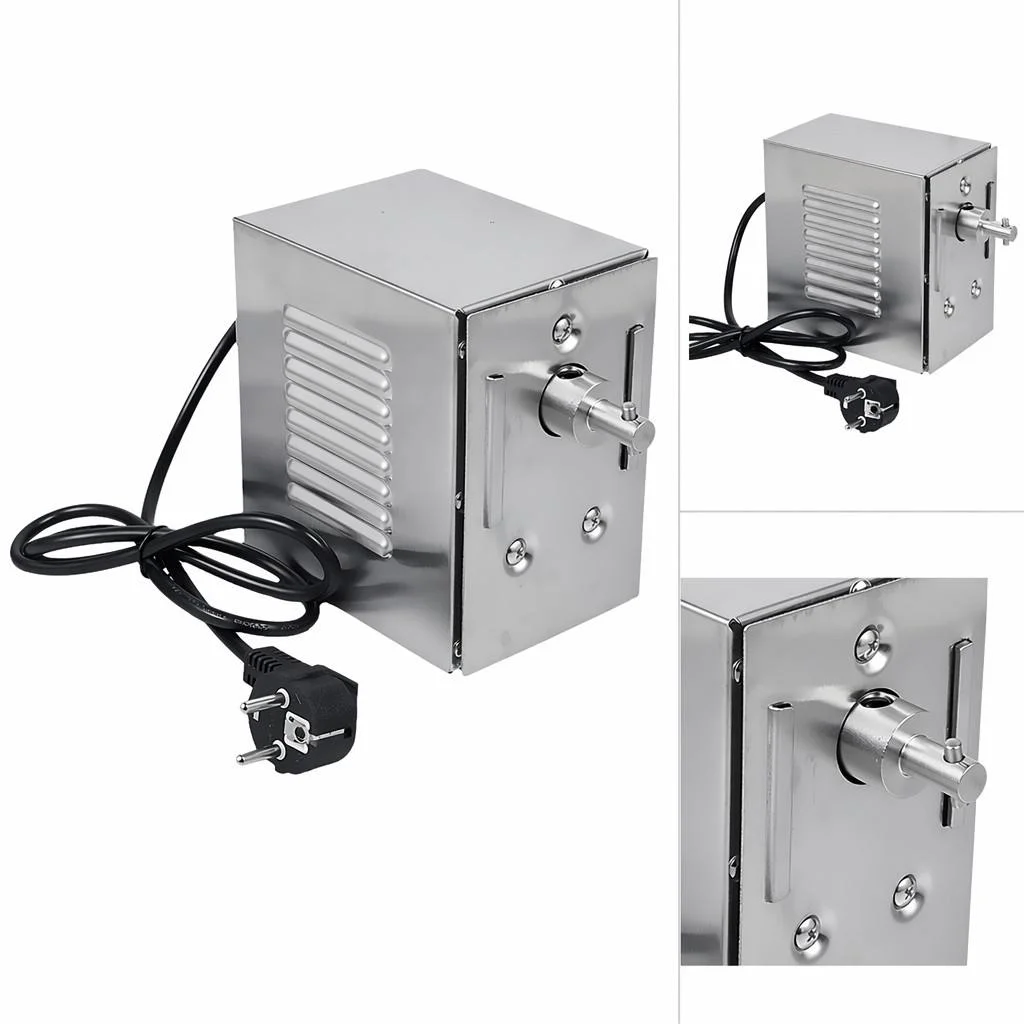
As a specialized BBQ grill and rotisserie machinery manufacturer in Liaoning, Liaoning Toshine Metal Technology Co., Ltd. provides end-to-end OEM and ODM contract manufacturing services for international commercial brands, distributors, and catering equipment suppliers:
- Custom Dimensional Fabrication: Firebox lengths from 1000mm up to 2000mm, with options for dual-fuel gas assist burners, charcoal basket dividers, and wind-guards.
- Motor Specification Customization: Custom gear ratios, variable speed controllers (PWM), worldwide voltage compliance (UL, CE, SAA, UKCA), and custom stainless steel motor housings.
- Private Label & Laser Engraving: High-precision CNC fiber laser engraving for brand logos, customized packaging, and assembly manuals.
- Strict Quality Assurance: 100% 72-hour continuous motor burn-in testing, load testing under 1.5x nominal payload, and food-grade material certification (FDA / LFGB / RoHS).
Looking for Custom Rotisserie Spit Roasters & High-Torque Motors?
Direct factory pricing, custom DFM engineering support, and rapid sample prototyping (3–5 business days). Contact our engineering team today for technical catalogs, CAD drawings, and volume quotations.